What is digital stamping? As many of you know I am fairly new to the stamping world but have been working with ceramics and mixed media for as long as I care to remember. Card making in itself, if using two or more types of media is classed as mixed media. I have noticed recently in my searches on the internet that references to digital stamping are popping up more and more so I decided to have a look to see what it was all about.
It turns out that this is something I have been doing for years using Photoshop and Illustrator but had no idea it had a name!
In the world of ceramics I produce digital images to be printed into waterslide decals which can then be fired into the surface of the glaze.
Ok ok I will get to the point! Image transfer onto a glazed pottery item using a ceramic waterslide decal is fairly easy. But what if I want to apply my digital images to unglazed pottery, wood or canvas and get a lovely crisp result?
At first I was going to try the Golden gel medium technique but unfortunately there was none to hand so I tried it with a few products from the Decoart range…. I love to experiment!
One product that worked fantastically and is far cheaper was the Americana
DuraClear Satin Varnish.
Can I just point out I do not work for
Decoart or receive any commission from sales of there products. (DecoArt if your listening I need new strings for my guitar!

).
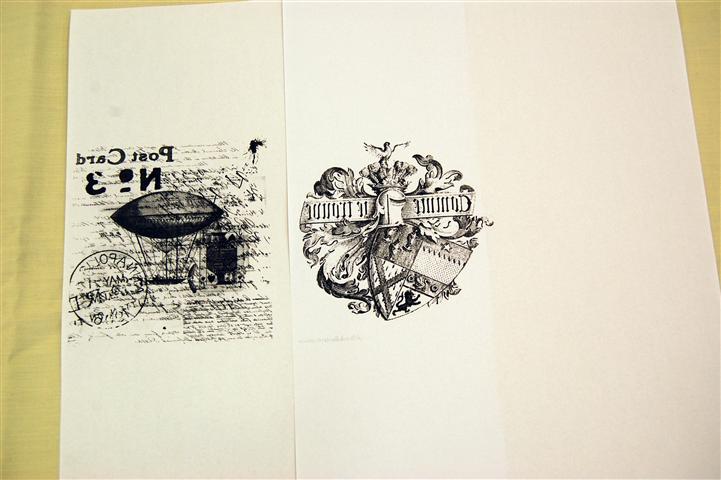
Ok I printed out a few of my designs pictured below apart from the second image which came from
The Graphics Fairy. A really good resource for royalty free images. All images were printed on a laser copier, not sure at this stage if inkjet will work.


For surface preparation apply one good coat of acrylic paint to the piece.

Next print a mirror image of the artwork to the desired size. This is important if text is to be included.

Cut out you image using a pair of scissors.

Once the acrylic basecoat is dry, apply a thick layer of DuraClear satin varnish to the surface, make sure the entire surface is covered.

Immediately place the artwork print side down onto the piece and run over the surface with a brayer several times to remove any air pockets and to ensure good adhesion.

Dry the piece with a heat tool for approximately five minutes. Dampen the paper with water and start gently rubbing the surface with fingers turning the paper into pulp and removing the first layer of paper.

Note: This technique will most probably work best if left to dry overnight but I am impatient.
Dry it with a heat tool for a further five minutes and leave to dry for one hour before returning it to the sink and removing the rest of the paper to reveal the transferred image.

It worked really well apart from one small area where the image came off. I think this was either because I should have let it dry for a longer period or I missed a part of the tile with the DuraClear varnish but on the whole I was very happy with the end results.

As these are to be used as coasters, I finished them with four coats of Americana Traditions Satin varnish for a durable alcohol resistant finish.

Next I tried the technique on some small canvases, the first one I really rushed the drying and some of the image came away but it looked kinda cool so out came the distress inks and I applied Vintage Photo gently to the canvas to antique it.

The second canvas I was a little more patient with!

Ok so to conclude this quick tutorial, if you want a perfect transfer leave it overnight to dry, you may find you need to score the paper first with some sand paper to allow the water to penetrate. For the grungy look or for the more impatient of you out there, use your heat tool and experiment with the times.
I am going to try this with DuraClear matte varnish on Monday as it should have a better adhesion, I will let you know the result's.
There are now two videos posted in the
video section of this blog on another very quick way to transfer images
Hope this has been of interest,
Andy



%5B2%5D.jpg "Faux Crystal Glaze Americana (Small)")


%5B3%5D.jpg "DSC_0250 (Medium)")
%5B3%5D.jpg "DSC_026 (Medium)")


%5B7%5D.jpg "orn034 (Small)")
%5B4%5D.jpg "digital stamp birds (Small)")
%5B4%5D.jpg "Digital Stamp Grunge (Small)")